Mon–Fri 9am – 5pm

Menu
Apartment Cleaning Contracts: How Cleaning Companies Win and Keep Multifamily Accounts
Last updated:
21 Oct 2026
Table of Contents
- What Are Apartment Cleaning Contracts?
- Who Hires Cleaning Vendors for Apartment Buildings?
- How Are Apartment Cleaning Contracts Different From Office Cleaning Contracts?
- How Do You Price an Apartment Cleaning Contract?
- Where Do You Find Apartment Cleaning Contracts?
- What Do Property Managers Expect in a Winning Bid?
- How Do Property Managers Measure Your Performance?
- What Mistakes Cost Cleaning Companies Apartment Contracts?
- Should You Outsource Appointment Setting for Apartment Accounts?
- FAQ
- Conclusion
Cleaning companies win apartment cleaning contracts by selling to property management companies rather than single buildings, and by bidding a two-part structure: a fixed monthly rate for common areas plus a separate per-unit rate for turnover cleaning. The people who decide are regional property managers, on-site managers, and maintenance supervisors. Winning bids name every area and frequency, state a complaint response time (24 to 48 hours is common), and include proof of insurance and bonding up front. Housing authorities and university housing also post apartment cleaning solicitations publicly on bid platforms. Accounts renew when the vendor meets the written scope and response time, so quality tracking matters as much as price.
Apartment cleaning contracts are some of the steadiest recurring accounts in commercial cleaning, because common areas need service constantly and every move-out creates a unit to turn. They are also easy to lose: vendors underprice the bid, cut labor hours mid-contract, and get rebid within a year. JanitorialAppointment.com works with commercial cleaning companies on exactly this problem, which is getting in front of the right decision-makers and bidding contracts that renew. This guide covers who hires, how to price, where to find the work, and what property managers expect to see.
What Are Apartment Cleaning Contracts?
An apartment cleaning contract is a written agreement between a property owner or management company and a cleaning vendor that defines the scope, frequency, and price of recurring cleaning for a multifamily property. Unlike a one-time invoice, it sets recurring obligations, usually monthly or annually, with renewal terms, cancellation clauses, and performance expectations in writing.
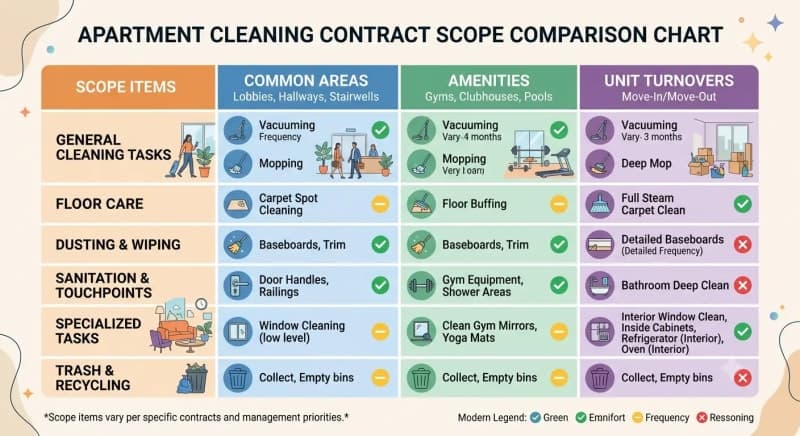
Most apartment cleaning contracts cover:
Common areas — lobbies, hallways, stairwells, elevators, mailrooms
Amenity spaces — fitness centers, clubhouses, pools, business centers
Unit turnover cleaning — deep cleans between tenants, usually billed per unit rather than on the recurring schedule
Exterior touchpoints — entryways, trash chutes, parking structures
A well-written contract also names who restocks supplies, who is liable for damage, and how missed cleanings get resolved.
Who Hires Cleaning Vendors for Apartment Buildings?
Apartment cleaning is usually bought by the management company, not by the individual building. A single signed management company can mean several properties, which is why the pitch should be a repeatable process rather than a one-building quote.
The people who sign or influence the decision:
Regional or portfolio property managers — own the vendor budget across multiple buildings.
On-site community managers and maintenance supervisors — see complaints daily and often shortlist vendors.
Owners and investment groups — approve larger contracts and care most about cost predictability.
Housing authorities and university student housing — post apartment cleaning and turnover solicitations publicly, with formal proposal requirements.
How Are Apartment Cleaning Contracts Different From Office Cleaning Contracts?
Office cleaning contracts are built around one tenant's business hours and a stable occupied footprint. Apartment contracts have to account for constant turnover, resident complaints, and spaces that never fully close. A hallway gets used at 2 a.m. the same as at 2 p.m., so a vendor who only shows up during weekday business hours will miss the traffic patterns that drive wear and complaints.
Three structural differences matter most:
Scheduling. Apartment work often runs early morning or in split shifts to avoid resident foot traffic, while office cleaning typically runs after hours.
Scope volatility. Unit turnovers rise and fall with lease cycles, so the contract needs a separate per-unit rate instead of one flat monthly number.
Accountability. Residents, not a single facilities director, often report problems, so the contract should state a response time for complaints.
Service provision is typically governed by long-term commercial cleaning contracts and detailed service level agreements — Technavio Research
How Do You Price an Apartment Cleaning Contract?
Price from your production rate and labor hours, not from what competitors quote. Labor is the largest cost in any cleaning contract; Housecall Pro's commercial cleaning pricing guide puts it at roughly half to four-fifths of total job cost. A bid that ignores real labor hours is the one that gets staffed thin by month four.
The median hourly wage for janitors and building cleaners was $17.27 in May 2024 — U.S. Bureau of Labor Statistics, Occupational Outlook Handbook
Apartment bids work best as two separate numbers: a fixed monthly rate for common areas and amenity spaces, and a documented per-unit rate for turnovers. That split keeps seasonal leasing swings from turning into billing disputes.
Should You Price Apartment Work Per Unit, Hourly, or Flat Rate?
Use a flat monthly rate for common areas, a per-unit rate for standard turnovers, and hourly pricing only for one-off extras such as heavily soiled units or post-renovation cleanup. Mixing the models inside one contract is normal, as long as each line item says which model applies.
A per-unit turnover rate moves with:
Unit size and layout
Condition at move-out, including buildup and pet hair
Standard turn versus deep clean
Required completion time after move-out
Where Do You Find Apartment Cleaning Contracts?
The work comes from four places, and most successful cleaning companies use more than one:
Direct outreach to management companies. Target property managers and maintenance supervisors, not leasing offices.
Apartment association meetings and local events. These put you in the same room as the people who choose vendors.
Public bid listings. Housing authorities, municipal housing, and university student housing post cleaning and turnover solicitations. Aggregators such as SamSearch track them by category.
Referrals from existing accounts. A maintenance supervisor who trusts you will mention you to the next property.
Cold outreach is where most cleaning company owners stall, because decision-makers are hard to reach and follow-up is inconsistent. Commercial Cleaning Appointment Setting handles the calling and books qualified walkthroughs, so your time goes to bidding instead of dialing. If you also need a steady list of prospects to work, Janitorial Lead Generation covers sourcing management companies and properties. For the bidding side, see how to bid commercial cleaning jobs and how to find commercial cleaning contracts beyond apartments.
What Do Property Managers Expect in a Winning Bid?
Property managers compare bids against one scope document, so the strongest proposals answer every question before it is asked. A winning apartment bid includes:
Exact areas covered, listed by name rather than by category
Cleaning frequency per area (daily, weekly, per turnover)
Supplies and equipment the vendor provides
Staffing levels, and whether a supervisor does periodic quality checks
A fixed base rate plus a per-unit turnover rate
A communication protocol with one point of contact on each side and a stated response time (24 to 48 hours is common)
A termination clause with a defined notice period (30 to 60 days is standard)
An annual price review tied to a transparent factor, such as minimum wage changes or a published cost index
A current Certificate of Insurance and proof of bonding, provided before signing rather than promised afterward
How Do Property Managers Measure Your Performance?
Cost per square foot is the number most owners start with, but it is an incomplete measure. A cheaper rate that comes with missed cleanings, resident complaints, and a mid-contract vendor exit costs a property more in staff time and reputation than a slightly higher rate that holds steady. Expect to be judged on these:
Track these yourself and send a short monthly report. A manager who sees complaint volume falling and response times under 48 hours has little reason to open the contract for rebid.
What Mistakes Cost Cleaning Companies Apartment Contracts?
Most lost apartment accounts trace back to a handful of avoidable errors:
Underpricing to win, then cutting hours to survive. The property notices within weeks, and the contract is rebid within 12 to 18 months.
Pricing from a written scope without walking the building. Disputes start the first time you see the actual spaces.
No defined per-unit turnover rate. Every lease-up season becomes a billing argument.
No clear escalation path for missed cleanings. Managers want to know who gets notified and what happens next.
Skipping insurance and bonding paperwork. A bid without a current Certificate of Insurance often never reaches the comparison stage.
Treating the property manager as the only contact. Maintenance supervisors see the work daily and influence renewals.
Should You Outsource Appointment Setting for Apartment Accounts?
Outsourcing makes sense when your crews are busy and nobody on your team has time to call property managers consistently. B2B Cleaning Sales Outsourcing partners can run outreach while you focus on delivery. Before you hire one, check five things:
Do they target property management companies and named decision-makers, not general inboxes?
How do they define a qualified appointment, and is that definition written down?
Do they understand bid cycles, walkthroughs, and renewal windows?
Will you see call and appointment reporting, not just a monthly total?
Can they show results for cleaning or facility-services companies specifically?
FAQ
Who hires cleaning companies for apartment buildings?
Property management companies hire most apartment cleaning vendors, with regional managers, on-site community managers, and maintenance supervisors involved in the decision. Housing authorities and university student housing also hire through public solicitations.
How do you price apartment turnover cleaning?
Apartment turnover cleaning is priced per unit, based on unit size, move-out condition, whether it is a standard turn or deep clean, and the required completion time. Common areas are priced separately as a fixed monthly rate.
How is an apartment cleaning contract different from an office cleaning contract?
Apartment contracts account for round-the-clock occupancy, resident complaints, and fluctuating turnover volume, so they pair a monthly common-area rate with a per-unit rate. Office contracts run after hours on a stable footprint with a flat monthly rate.
How long should an apartment cleaning contract term run?
One year is standard, paired with a 30 to 60 day termination clause so either side can exit if the relationship is not working. Multi-year terms are usually earned after a vendor proves reliable on a first-year contract.
Where can I find apartment cleaning contracts?
Apartment cleaning contracts come from direct outreach to management companies, apartment association events, referrals, and public bid listings from housing authorities and universities. Many cleaning companies also use appointment setting to reach property managers consistently.
What insurance do you need to bid on apartment cleaning contracts?
Most property managers require a current Certificate of Insurance and proof of bonding before signing. Required coverage limits vary by property and management company, so ask for the insurance requirements in the bid package before you submit pricing.

Conclusion
Apartment cleaning contracts reward cleaning companies that price from real labor hours, split common areas from per-unit turnovers, and put every area, frequency, and response time in writing. The accounts that renew are the ones where the vendor tracks complaints and response times before the property manager asks.
If you want more apartment and multifamily walkthroughs on your calendar, JanitorialAppointment.com books appointments with property managers and facility decision-makers for commercial cleaning companies, so you can spend your time bidding instead of cold calling.
Connect With Us
Have questions? Want to learn more? Reach out to us on WhatsApp or follow us on Facebook for updates and tips.


